


The entire premise of this book is impossible to resist, a sort of guide to marriage counseling through the eyes of the zombie apocalypse.
Sarah and Dave are having marriage problems and have been attending marriage counseling. Both are somewhat ready to throw in the towel but when they arrive at counseling, they notice everyone is missing. Upon going into their counselor's office, they see her feasting on the couple that goes in before them. And, well, the zombies have arrived.
The story then follows what Sarah and Dave do as zombies begin to take over their city of Seattle. And while they are forced together in this crisis, they begin to deal with some of their marriage issues.
Each chapter starts with a little marriage tip for the zombie apocalypse such as my favorite, "Put the small stuff into perspective. It's better to be wrong and alive than right but eating brains." And the book is really funny. While I might get in a little bit of trouble for saying this, it reminds me of the best of chick lit...a strong snarky first person female voice that is instantly likable and a pleasure to read. Another one of my favorite funny bits, when Sarah has to tell her neighbor she killed her zombieified boyfriend "I shifted, throughly uncomfortable with what I'd done. Hallmark didn't exactly made a card for this situation (well they do now, but not then) so I wasn't sure what to say to her so that she'd understand I hadn't done this out of spite."
Lest you think it's all fun and games, well it's not. It is a zombie apocalypse so there are some horrifying moments and LOTS of gore. Never enough tragedy to bring the tears I so dearly love to shed during most zombie books, but not all fun and games.
A very fun way to spend the afternoon and best part? Flip This Zombie, book 2, is out in January.
Rating: 4/5
Things You Might Want to Know: Profanity, lots of it. Gore. Zombies
Source of Book: Review copy from the publisher
Publisher: Orbit
Sunday, October 31, 2010
Review: Married with Zombies by Jesse Petersen
Friday, October 29, 2010
Faith and Fiction Saturday Round Table: Something Wicked This Way Comes by Ray Bradbury

First a few administrative things. Next month's read, Resurrection in May by Lisa Samson will be the final round table of the year. There are still some open spots if you'd like to participate.
Next Saturday I'll be making an announcement about the future of Faith and Fiction Round Table so make sure you check in!
This month we discussed Ray Bradbury's classic Halloween tale, Something Wicked This Way Comes.
About the Book: Few American novels written this century have endured in th heart and mind as has this one-Ray Bradbury's incomparable masterwork of the dark fantastic. A carnival rolls in sometime after the midnight hour on a chill Midwestern October eve, ushering in Halloween a week before its time. A calliope's shrill siren song beckons to all with a seductive promise of dreams and youth regained. In this season of dying, Cooger & Dark's Pandemonium Shadow Show has come to Green Town, Illinois, to destroy every life touched by its strange and sinister mystery. And two inquisitive boys standing precariously on the brink of adulthood will soon discover the secret of the satanic raree-show's smoke, mazes, and mirrors, as they learn all too well the heavy cost of wishes -- and the stuff of nightmare.
This month's participants:
Section 1: Wordlily
Section 2: Linus's Blanket
Section 3: My Random Thoughts
About Our Faith
Amy: I'm a Christian, grew up in the evangelical church but have become a lot more liberal and less literal in my faith and am currently trying to figure out exactly where I fit in.
Jacob: I'm Jacob Ritari, author of Taroko Gorge, released July of this year. I'm currently studying Japanese language at the Inter-University Center in Yokohama.
Religiously, I was raised humanist/Jewish; my parents practiced until their divorce. I converted to Christianity in high school and attended the local Methodist church. I was attracted by the extreme side of religion described by authors like Graham Greene and Flannery O'Connor, and it wasn't until college really that I read actual theology and became more serious about it. I attended Trinity Grace in New York City, a nondenominational church I think does really exciting things. Today I probably identify with the so-called "Emerging Church Movement," people like Jim Wallis and Brian MacLaren.
At the same time, after Newman, I'm watchful of the boundary between faith and fiction; and I doubt many people would guess I believed from reading my first novel, which is very much about skepticism. I'm quiet about my faith from day-to-day too; something my pastor in New York said really stuck with me: "God tells us, 'you don't convert people, I do.'" Still I would basically call myself evangelical.
Hannah: I'm a Christian. I grew up in the church. My understanding of what it means to follow Jesus has changed numerous times, and I'm guessing I haven't reached any sort of final conclusion on that yet.
Nicole: I'm Nicole and I blog at Linus's Blanket. I was raised as a Christian, was baptized, and from childhood attended church services until I went to college. I have always been interested in how the teachings of religion square with real life practices. What I have observed has left me wary of the traditional practice of religion, though I have retained the faith that there is an existing organizing power at work in the world.
Thomas: My name is Thomas and I am a Christ follower and at time I suck at it. I did not grow in the church. I grew up around the church thanks to friends who did grow up in the church. I came to faith late in my life so I am still trying to figure out what this all means.
Jason: I'm Jason Gignac, I grew up in the LDS faith, but am now sort of a doubtful inbetweener, something between an atheist and a dystheist, but not one who assumes that what he thinks is correct. I love religion, I was originally going to study religion and mythology and folklore in school, because I love the way people can believe in things, I think it's beautiful. I just can't manage it myself, I guess.
The Vampire Diaries Discussion and Recap 2.7: Masquerade

I loved this episode! Since I'm so late in getting this up, I just want to hit on a few things. Please share your thoughts in comments!
I love Damon and Stefan scheming together! Seriously the hotness is overwhelming. I thought the plan was pretty good, too, but Katherine really had a good plan in having all damage done to her be done to Elena.
And thank God Bonnie finally had a big part and Lucy told her she'd have more of a part!
Also, I was glad that Matt didn't die though both of those poor girls, did! And now that Tyler's all tortured, he's growing on me. Even Jeremy (who has the hots for Bonnie!!!) is growing on me. I love this show!
Speaking of, what do you think of Bonnie and Jeremy? In some ways, I think that they'd actually be a good match fighting for good together.
Even though it annoyed me that Elena snuck out to go the party, it was a good thing because otherwise they might not have known that Elena was getting hurt when they hurt Katherine.
Caroline continues to grow in awesomeness.
And who else is trying to kill Elena??? And just how long will Katherine stay down in that tomb?
Share all your thoughts with me! Also, Elena and Stefan = still broken up! Room for Damon!
Thursday, October 28, 2010
FIRST: The God Hater by Billy Myers
 It is time for a FIRST Wild Card Tour book review! If you wish to join the FIRST blog alliance, just click the button. We are a group of reviewers who tour Christian books. A Wild Card post includes a brief bio of the author and a full chapter from each book toured. The reason it is called a FIRST Wild Card Tour is that you never know if the book will be fiction, non~fiction, for young, or for old...or for somewhere in between! Enjoy your free peek into the book!
You never know when I might play a wild card on you!

and the book:
Howard Books; Original edition (September 28, 2010)

Bill Myers is an author, screenwriter, and director whose work has won more than fifty national and international awards, including the C.S. Lewis Honor Award.
Visit the Book Specific Site.
Visit the author's website.
Product Details:
List Price: $14.99
Paperback: 320 pages
Publisher: Howard Books; Original edition (September 28, 2010)
Language: English
ISBN-10: 1439153264
ISBN-13: 978-1439153260
AND NOW...THE FIRST CHAPTER:

The sixty-something professor stared silently at his wristwatch. He had unruly white hair and wore an outdated sports coat.
“Dr. Mackenzie?”
He glanced up, disoriented, then turned to the host who repeated the question. “What are your feelings about the book?”
Clearing his throat, Mackenzie raised the watch to his ear and gave it a shake. “I was wondering . . .” He dropped off, his bushy eyebrows gathered into a scowl as he listened for a sound.
The second guest, a middle-aged pastor with a shirt collar two sizes too small, smiled, “Yes?”
Mackenzie gave up on the watch and turned to him. “Do you make up this drivel as you go along? Or do you simply parrot others who have equally stunted intellects?”
The pastor, Dr. William Hathaway, blinked. Still smiling, he turned back to the host. “I was under the impression we were going to discuss my new book?”
“Oh, we are,” Preston assured him. “But it’s always good to have a skeptic or two in the midst, wouldn’t you agree?”
“Ah,” Hathaway nodded, “of course.” He turned back to Mackenzie, his smile never wavering. “I am afraid what you term as ‘drivel’ is based upon a faith stretching back thousands of years.”
Mackenzie removed one or two dog hairs from his slacks. “We have fossilized dinosaur feces older than that.”
“I’m sorry?”
“Just because something’s old, doesn’t stop it from being crap.”
Dr. Hathaway’s smile twitched. He turned in his chair so he could more fully address the man. “We’re talking about a time honored religion that millions of —”
“And that’s supposed to be a plus,” Mackenzie said, “that it’s religious? I thought you wanted to support your nonsense.”
“I see. Well it may interest you to know that—“
“Actually, it doesn’t interest me at all.” The old man turned to Preston. “How much longer will we be?”
The host chuckled. “Just a few more minutes, Professor.”
Working harder to maintain his smile, Hathaway replied, “So, if I understand correctly, you’re not a big fan of the benefits of Christianity?”
“Benefits?” Mackenzie pulled a used handkerchief from his pocket and began looking for an unsoiled portion. “Is that what the 30,000 Jews who were tortured and killed during the Inquisition called it? Benefits?”
“That’s not entirely fair.”
“And why is that?”
“For starters, most of them weren’t Jews.”
“I’m sure they’re already feeling better.”
“What I am saying is—”
“What you are saying, Mr . . . Mr—”
“Actually, it’s Doctor.”
“Actually, you’re a liar.”
“I beg your pardon?”
Finding an unused area of his handkerchief, Mackenzie took off his glasses and cleaned them.
The pastor continued. “It may interest you to know that—”
“We’ve already established my lack of interest.”
“It may interest you to know that I hold several honorary doctorates.”
“Honorary doctorates.”
“That’s correct.”
“Honorary, as in unearned, as in good for nothing . . . unless it’s to line the bottom of bird cages.” He held his glasses to the light, checking for any remaining smudges.
Hathaway took a breath and regrouped. “You can malign my character all you wish, but there is no refuting the benefits outlined in my new book.”
“Ah yes, the benefits.” Mackenzie lowered his glasses and worked on the other lens. “Like the million plus lives slaughtered during the Crusades?”
“That figure can be disputed.”
“Correct. It may be higher.”
Hathaway shifted in his seat. “The Crusades were a long time ago and in an entirely different culture.”
“So you’d prefer something closer to home? Perhaps the witch hunts of New England?”
“I’m not here to—”
“Fifteen thousand human beings murdered in Europe and America. Fifteen thousand.”
“Again, that’s history and not a part of today’s—”
“Then let us discuss more recent atrocities—towards the blacks, the gays, the Muslim population. Perhaps a dialogue on the bombing of abortion clinics?”
“Please, if you would allow me—”
Mackenzie turned to Preston. “Are we finished here?”
Fighting to be heard, Hathaway continued. “If people will read my book, they will clearly see—”
“Are we finished?”
“Yes, Professor,” Preston chuckled. “I believe we are.”
“But we’ve not discussed my Seven Steps to Successful—”
“Perhaps another time, Doctor.”
Mackenzie rose, shielding his eyes from the bright studio lights as Hathaway continued. “But there are many issues we need to—”
“I’m sure there are,” Preston agreed while keeping an eye on Mackenzie who stepped from the platform and headed off camera. “And I’m sure it’s all there in your book. Seven Steps to—”
***
Annie Brooks clicked off the remote to her television.
“Mom,” Rusty mumbled, “I was watching . . .” he drifted back to sleep without finishing the protest.
She looked down at the five year old and smiled. He lay in bed beside her, his hands still clutching Horton Hears a Who! Each night he’d been reading it to her, though she suspected it was more reciting from memory than reading. She tenderly kissed the top of his head before absent-mindedly looking back to the TV.
He’d done it again. Her colleague and friend—if Dr. Nicholas Mackenzie could be said to have any friends—had shredded another person of faith. This time a Christian, some mega-church pastor hawking his latest book. Next time it could just as easily be a Jew or Muslim or Buddhist. The point was that Nicholas hated religion. And Heaven help anybody who tried to defend it.
She sighed and looked back down to her son. He was breathing heavily, mouth slightly ajar. She brushed the bangs from his face and gave him another kiss. She’d carry him back to bed soon enough. But for now she would simply savor his presence. Nothing gave her more joy. And for that, with or without Nicholas’ approval, Annie Brooks was grateful to her God.
* * * * *
“Excuse me?” Nicholas called from the back seat of the Lincoln Town Car.
The driver didn’t hear.
He leaned forward and spoke louder. “You just passed the freeway entrance.”
The driver, some black kid with a shaved head, turned on the stereo. It was an urban chant, its beat so powerful Nicholas could feel it pounding in his gut. He unbuckled his seat belt and scooted to the open partition separating them. “Excuse me! You—”
The tinted window slid up, nearly hitting him in the face.
He pulled back in surprise, then banged on the glass. “Excuse me!” The music was fainter but still vibrated the car. “Excuse me!”
No response.
He slumped back into the seat. Stupid kid. And rude. He’d realize his mistake soon enough. And after Nicholas’ call to the TV station tomorrow, he’d be back on the streets looking for another job. Trying to ignore the music, Nicholas stared out the window, watching the Santa Barbara lights soften as fog rolled in. Over the years the station’s drivers had always been polite and courteous. Years, as in Nicholas was a frequent guest on God Talk. Despite his general distain for people, not to mention his reclusive lifestyle, he always accepted the producer’s invitation. Few things gave him more pleasure than exposing the toxic nature of religion. Besides, these outings provided a nice change of pace. Instead of the usual stripping away of naïve college students’ faith in his classroom, the TV guests occasionally provided a challenge.
Occasionally.
Other than his duties at the University of California Santa Barbara, these trips were his only exposure to the outside world. He had abandoned society long ago. Or rather, it had abandoned him. Not that there was any love lost. Today’s culture was an intellectual wasteland—a world of pre-chewed ideas, politically correct causes, sound bite news coverage, and novels that were nothing more than comic books. (He’d given up on movies and television long ago.) Why waste his time on such pabulum when he could surround himself with Sartre, Hegel, Kierkegaard, Nietzsche—men whose work would provide more meaningful companionship in one evening than most people could in a lifetime.
Nevertheless, he did tolerate Ari, even fought to keep her during the divorce. She was his faithful companion for over fifteen years, though he should have put her down months ago. Deaf and blind, the golden retriever’s hips had begun to fail. But she wasn’t in pain. Not yet. And until that time, he didn’t mind cleaning up after her occasional accidents or calling in the vet for those expensive house calls. He owed her that. Partially because of her years of patient listening, and partially because of the memories.
The car turned right and entered a residential area. He glanced down to the glowing red buttons on the console beside him. One of them was an intercom to the driver. But, like Herbert Marcuse, the great Neo-Marxist of the 20th Century (and, less popularly, Theodore Kaczynski, the Unabomber of the 1980s) Nicholas mistrusted modern technology as much as he scorned the society that created it. How many times had Annie, a fellow professor, pleaded with him to buy a telephone . . .
“What if there’s an emergency?” she’d insisted. “What if someone needs to call you?”
“Like solicitors?”
“They have Do Not Call lists,” she said. “You can go online and be added to their—”
“Online?”
“Okay, you can write them a letter.”
“And give them what, more personal information?”
“They’d only ask for your phone number.”
“Not if I don’t have one.”
And so the argument continued off and on for years . . . as gift occasions came and went, as his closet gradually filled with an impressive collection of telephones. One thing you could say about Annie Brooks, she was persistent—which may be why he put up with her company, despite the fact she doted over him like he was some old man who couldn’t take care of himself. Besides, she had a good head on her shoulders, when she chose to use it, which meant she occasionally contributed something of worth to their conversations.
Then, of course, there was her boy.
The car slowed. Having no doubt learned the error of his ways, the driver was turning around. Not that it would help him keep his job. That die had already been cast. But the car wasn’t turning. Instead, it pulled to the curb and came to a stop. The locks shot up and the right rear door immediately opened. A man in his early forties appeared—strong jaw, short hair, with a dark suit, white shirt, and black tie.
“Good evening, Doctor.” He slid onto the leather seat beside him.
“Who are you?” Nicholas demanded.
The man closed the door and the car started forward. “I apologize for the cloak and dagger routine, but—”
“Who are you?”
He flipped open an ID badge. “Brad Thompson, HLS.”
“Who?”
“Homeland Security Agent Brad Thompson.” He returned the badge to his coat pocket.
“You’re with the government?”
“Yes sir, Homeland Security.”
“And you’ve chosen to interrupt my ride home because . . .”
“Again, I apologize, but it’s about your brother.”
Nicholas stared at him, giving him no satisfaction of recognition.
“Your brother,” the agent repeated, “Travis Mackenzie?”
Nicholas held his gaze another moment before looking out the window. “Is he in trouble again?”
“Has he contacted you?”
“My brother and I seldom communicate.”
“Yes, sir, about every eighteen months if our information is correct.”
The agent’s knowledge unsettled Nicholas. He turned back to the man. “May I see your identification again?”
“Pardon me?”
“Your identification. You barely allowed me to look at it.”
The agent reached back into his suit coat. “Please understand this is far more serious than his drug conviction, or his computer hacking, or the DUIs.”
Nicholas adjusted his glasses, waiting for the identification.
The agent flipped open his ID holder. “We at HLS are very concerned about his involvement—”
Suddenly, headlights appeared through the back window, their beams on high. The agent looked over his shoulder, then swore under his breath. He reached for the intercom, apparently to give orders to the driver, but the town car was already beginning to accelerate.
“What’s the problem?” Nicholas asked.
The car turned sharply to the left and continued picking up speed.
“I asked you what is happening,” Nicholas repeated.
“Your brother, Professor. Where is he?”
The headlights reappeared behind them, closing in.
“You did not allow me to examine your identification.”
“Please, Doctor—”
“If you do not allow me to examine your identification, I see little—”
“We’ve no time for that!”
The outburst stopped Nicholas as the car took another left, so sharply both men braced themselves against the seat.
The agent turned back to him. “Where is your brother?”
Once again the lights appeared behind them.
Refusing to be bullied, Nicholas repeated, “Unless I’m convinced of your identity, I have little—”
The agent sprang toward him. Grabbing Nicholas’ shirt, he yanked him to his face and shouted, “Where is he?!”
Surprised, but with more pride than common sense, Nicholas answered. “As I said—”
The agent’s fist was a blur as it struck Nicholas’ nose. Nicholas felt the cartilage snap, knew the pain would follow. As would the blood.
“WHERE IS HE?”
The car turned right, tires squealing, tossing the men to the other side. As Nicholas sat up, the agent pulled something from his jacket. There was the black glint of metal and suddenly a cold gun barrel was pressed against his neck. He felt fear rising and instinctively pushed back the emotion. It wasn’t the gun that concerned him, but the fear. That was his enemy. If he could focus, rely on his intellect, he’d have the upper hand. Logic trumped emotion every time. It was a truth that sustained him through childhood, kept him alive in Vietnam, and gave him the strength to survive in today’s world.
The barrel pressed harder.
When he knew he could trust his voice, he answered, “The last time I saw my brother was Thanksgiving.”
The car hit the brakes, skidding to a stop, sliding Nicholas off the seat and onto his knees. The agent caught himself, managing to stay seated. Up ahead, through the glass partition, Nicholas saw a second vehicle racing toward them—a van or truck, its beams also on high.
The agent pounded the partition. “Get us out of here.” he shouted at the driver. “Now!”
The town car lurched backward. It bounced up a curb and onto a front lawn. Tires spun, spitting grass and mud, until they dug in and the vehicle took off. It plowed through a hedge of junipers, branches scraping underneath, then across another lawn. Nicholas looked out his side window as they passed the first vehicle which had been behind them, a late model SUV. They veered back onto the road, snapping off a mailbox. Once again the driver slammed on the brakes, turning hard to the left, throwing the vehicle into a 180 until they were suddenly behind the SUV, facing the opposite direction. Tires screeched as they sped off.
The agent hit the intercom and yelled, “Dump the Professor and get us out of here!”
The car continued to accelerate and made another turn.
Pulling Nicholas into the seat and shoving the gun into his face, the agent shouted, “This is the last time I’m asking!”
Nicholas’ heart pounded, but he kept his voice even. “I have already told you.”
The man chambered a round. But it barely mattered. Nicholas had found his center and would not be moved. “I have not seen him in months.”
“Thanksgiving?”
“Yes.”
The car made another turn.
“And?”
Nicholas turned to face him. “We ate a frozen dinner and I sent him away.”
The agent searched his eyes. Nicholas held his gaze, unblinking. The car took one last turn, bouncing up onto an unlit driveway, then jerked to a stop. There was no sound, except the pounding music.
“Get out,” the agent ordered.
Nicholas looked through the window. “I have no idea where we—”
“Now.”
Nicholas reached for the handle, opened his door and stepped outside. The air was cold and damp.
“Shut the door.”
He obeyed.
The town car lunged backward, lights off. Once it reached the road it slid to a stop, changed gears and sped off. Nicholas watched as it disappeared into the fog, music still throbbing even after it was out of sight. Only then did he appreciate the pain in his nose and the warm copper taste of blood in his mouth. Still, with grim satisfaction, he realized, he had won. As always, logic and intellect had prevailed.
CFBA Book Spotlight: A Season of Miracles by Rusty Whitener

Gunning for the championship is all that matters until twelve-year-old Zack meets Rafer, a boy whose differences make him an outcast but whose abilities on the baseball field make him the key to victory.
Admired for his contribution to the team, Rafer turns everyone’s expectations upside down, bestowing a gift to Zack and his teammates that forces them to think—is there more to life than winning or losing? And what is this thing called grace?
I started this and am not very far. I received a copy of this book from the publisher, Kregal.
Review: Feed by Mira Grant

So I've kind of learned I have a thing for zombie stories. I think it's the mix of the apocalyptic sort of atmosphere and the tragedy. So much TRAGEDY in zombie stories because it's so EASY to get infected. And there might be some other deeper psychological reasons (that probably point to me being slightly nuts), but in any case, I was delighted to finally have a chance to read Mira Grant's Feed this past week.
Which was awesome! Feed takes place 25 years after the virus first broke out, so the world definitely has coping mechanisms now and zones of hazard and safety and all sorts of laws against big animals and taking like, 4 blood tests a day is completely normal. But what's really cool about this world? Bloggers are huge! The zombie outbreak was so mishandled by traditional news outlets that bloggers became the go to people for reliable information. And they've organized themselves and they have classifications and licenses and all kinds of stuff like that. Pretty awesome.
So our main character, Georgia, is a blogger, called a newsie. This means she hunts down the truth and reports facts as best she can. Georgia has an adoptive brother Shaun and these two are TIGHT, as Georgia says at one point, codependent. Not in any sick gross way, really, just that they are totally and completely comfortable with each other, they know each completely and trust each other that much, too. Shaun is the more adventurous sort (called an Irwin!)..he likes to go out in the field and taunt the zombies for amusements sake.
Georgia, Shaun, and their coblogger Buffy (yes Buffy--just how much do you love Mira Grant right now?) get invited to follow a presidential candidate's campaign. This means that they will have complete access to the candidate as he runs and also that their ratings will shoot through the roof. (they got rid of traffic as a measurement of blog popularity after the zombie apocalypse)
What this means is that Feed can be enjoyed on many levels. If you really like political thrillers it's a bit of one of those. If you love blogging, you're not going to top this. If you love close family relationships in your book, you've got that. If you like zombies...they are very present. Feed has a lot going for it.
What I loved about this book was the world building was so good! The explanation for the zombie virus made a lot of sense. The way the world recovered and moved on was fascinating. The fact that EVERYONE carries the virus in them and it activates on death is so rich with meaning I loved it. Using blogging as such a huge part of the story provided a glimpse into how a zombie's craving for flesh is a bit like our craving for information. And the fact that San Diego Comic-con got a mention was super cool because I saw Mira Grant on a zombie panel there and she was delightful and funny!
Feed is told in first person perspective. It is not in any way a romance. There are zombies. There is death. The dead rise again...but only to eat your brains. There's a lot of action and a lot of mystery. And the biggest compliment I can pay it is that when I wasn't reading it, I was wishing I was reading it.
Rating: 4.25/5
Things You Might Want to Know: Profanity. Also, zombies (and I would say a slightly unfavorable view of religious people)
Source of Book: Received for review from publisher
Publisher: Orbit
And Mira Grant is also Seanan McGuire who writes urban fantasy!
Excerpt: Don't Ever Look Down by Dick and Debbie Church

DON'T EVER LOOK DOWN: SURVIVING CANCER TOGETHER
by Dick and Debbie Church, with Diane Moody
Sheaf House Publishers, LLC
ISBN 978-0-9824832-3-7
$13.99
Due out in April 2011
BOOK DESCRIPTION:
Marriages don’t always survive cancer, even when patients do. In this unique book, the authors share their journey through cancer as husband and wife with honesty, humor, and hope. DON'T EVER LOOK DOWN offers encouragement and practical advice to couples who are facing the same steep mountain climb.
As an oncology counselor, Debbie Church worked with hundreds of cancer patients. Through her own experience with this disease, she gained a greater understanding of cancer’s impact on individuals and families. Her husband, Dick, shares a man’s perspective on entering the mysterious worlds of gynecology and oncology. An experienced mountain climber, Dick compares Debbie's battle with cancer to the difficulties, dangers, and triumphs of climbing a mountain.
EXCERPT:
"As I sat in my chair, I tried to lean forward and watch the images appearing on the
monitor. I prayed so hard . . . harder than I have ever prayed.
Does she see anything? Does it look bad? Is Deb okay? Is this a false alarm?
Dr. Corgan pinpointed the location of the questionable area and did a needle biopsy. I kept praying. Please God, please don’t let anything be wrong . . . especially not cancer! Deb prayed hard too.
A small piece of tissue was removed. I’ll never forget the image of Deb lying on that table. Thin streaks of blood flowed down her left breast from the small puncture, absorbing into her paper blouse. It was so surreal.
This should not be happening, I thought. Deb does not deserve this.
But she was so brave.
I kept praying. Please God. Please!
As an oncology counselor, Deb knew the process and exactly what doctors can surmise
without a full pathology report. “Does it look cancerous?” Deb’s question filled the room with anxiety, fear, and trembling. Hope hung on every word, but barely.
“Yes.”
Dr. Corgan placed the tissue sample in a small vial and labeled it Debbie Church.
“Without a full pathology report, I can’t be 100 percent sure—but maybe ninety-nine.”
That was close enough. Deb knew Dr. Corgan had done thousands of biopsies like this and could usually tell.
My heart broke and fell to the floor. Life would never be the same again."
For more information, please see the following links:
Amazon
Author website
Tuesday, October 26, 2010
Lonesome Dove Readalong Discussion 4: Chapters 31-40

Is anyone not in love with this book at this point? Because I'm really really enjoying it. When I first thought to read this book I was worried it would be this dry boring Western. I'm so glad it's not! Thanks for reading along, everyone!
The discussion questions for this week are below. I wrote them this week, and have to admit it was a bit tough. Our responses are below. I look forward to seeing what you thought either in comments or on your blogs!
1 )Gus starts off this section, saying, "Here is where we all find out if we was meant to be cowboys." when Deets predicts a storm. Newt later observes that the only person who hadn't performed well in the storm was Sean. Did you predict at this point Sean would be the first casualty? How did his death impact you? What did you think of the way Gus and Call handled it?
2)Elmira and Loraine are both traveling on their own in the company of men. What do you think about the differences in their two situations? Which situation would you rather be in?
3)Roscoe is a bit pathetic out looking for July on his own when he runs across Louisa Brooks who proposes marriage in no time. What did you think of this unique character of Louisa and Roscoe's reaction to her?
Gus starts off this section, saying, "Here is where we all find out if we was meant to be cowboys." when Deets predicts a storm. Newt later observes that the only person who hadn't performed well in the storm was Sean. Did you predict at this point Sean would be the first casualty? How did his death impact you? What did you think of the way Gus and Call handled it?
Leah: I knew that they wouldn't make it through the whole journey without a death, of course there would be deaths, but two days in, and in such a violent manner, this was pretty sad to take in. Sean was so young and I think, I am not sure who it was Call or Gus, that said that is was just poor luck because it could have been anyone, it didn't matter how well trained you were. I think it would be hard to have to accept a death like that on the trail because it would really bring your morality into focus. It's especially poignant since Sean didn't seem to want to be in America in the first place.
Amy: I also thought it was really tragic! I thought the singing at the grave was kind of beautiful and I cried a little bit. It sounded like such a horrible way to go and the whole thing happened so quickly.
Melissa: This one shocked me! The visual of him being swarmed by water moccasins was awful! But the writing was so effective, I re-read it so I could immerse in the tragedy. I know the brothers played a minor role in this whole drama, but I loved the nuance their characters added – true “Irish Tenors!” I feel really sorry for the remaining one. I thought Gus and Call handled the best way they could: acknowledge it, remembered him, had a proper burial, and moved on.
Elmira and Loraine are both traveling on their own in the company of men. What do you think about the differences in their two situations? Which situation would your rather be in?
Leah: I love this question! Personally I would rather be on Lorrie's situation because I think the men she is travelling with probably care about her more as a person (yes she is a whore but at least they know her and like her!). They don't want anything bad to happen to her. If she gets fedup with Jake, you know Gus will take care of her and she has a bunch of money. Whereas Elmira, she's on that boat with a bunch of men she doesn't know. No thank you! Dreaming up some story, chasing after some man that left her.
Amy: Elmira's situation sounds terrible to me as well, I thought that part about how the men thought she belonged to them and in their eyes she didn't belong to herself to speak volumes. I also think Lorrie's in a much better situation!
Melissa: Well one thing Lorena has going for her – she is on land – she’s got the freedom (barely) to leave on a horse if she wants too. Elmira is stuck on a boat – nowhere to move -- so she doesn’t have a lot of options. And it has to smell (even worse than a bunch of dirty cowboys!). Honestly, both women’s situations stink (literally and figuratively). I still think I would rather be with Xavier on my way to San Francisco. So sad that women had so few choices.
Roscoe is a bit pathetic out looking for July on his own when he runs across Louisa Brooks who proposes marriage in no time. What did you think of this unique character of Louisa and Roscoe's reaction to her?
Leah: FUNNIEST CHAPTER EVER! Louisa was a hoot. She was in charge of her own life. She clearly was a great farmer who doesn't need a man but wants a man. This is in stark contrast to the previous women we've met so far. Whereas, Roscoe doesn't know what's hit him! As far as I can gather he's barely interacted with women before, which I think Louisa might even like about him. As far as she's concerned he can come back and be her companion. Love it!
Amy: I laughed SO MUCH during this chapter! Roscoe was so so so funny, when she proposed and laid out all the logic of it and he's like, well I don't want to. And then he starts to come around...ha!
Melissa: Seriously – laugh out loud funny! I love how McMurtry is weaving these vignettes throughout the book: This serious/dangerous cattle drive, juxtaposed with this comical, clown-like journey of Roscoe’s. A perfect example of “comic relief.” Leah, I must say, I’m almost jealous that you know what is around the corner! I secretly want to ask you, “so, what happens next??!!”
Monday, October 25, 2010
Review: The Faith and Values of Sarah Palin by Stephen Mansfield and David A. Holland
 This should be interesting. In fact, I almost didn't accept this book for review because I could imagine people's reactions to seeing something about Sarah Palin on my blog. But I have loved every book by Stephen Mansfield I've read. I find his books about the faith of politicians to be compassionately written with deep respect for the faith journeys of his subjects. He does write from the viewpoint of a person with faith and conservative values but never ever writes about his subjects as less than fully human. I am always moved by the insight I gain. It's a good reminder for me, I tend to want to write politicians off, but this book more than any other explores the cruel landscape of politics and the kind of courage it takes to even enter. There's a co writer for this book so I'm not sure exactly what each writer contributed, but this one does seem to want serve as a tool for understanding the potential Sarah Palin could have in the future.
Now, some background on me. When John McCain announced Sarah Palin as his running mate, I cried a little. I had no idea who she was, but I was raised Republican and I could recognize the significance of the moment. Sadly, I don't think Sarah Palin was ready for politics on such a huge scale. Even so, I have never been comfortable with the way the country treated her. The book opens up with several examples of how was treated in the media. I confess, I have never understood the sheer hatred from her political opponents. (apart from the anger that defines American politics today which the book also talks about a little.) Comments appearing in the New York Times along the lines of she's better suited as a calendar model, should make everyone feel ashamed. It's certainly not a sign of progression.
Anyway off my soap box, the book opens talking about her parents and their decision to move to Alaska and how deeply the land of Alaska itself is a part of who Sarah Palin is. I found this part really interesting, about her deep love of the land and the way it's a part of all Alaskans. It's certainly true from the transplanted Alaskans I've known. The authors suggest that this connection with the land and the sort of pioneer lifestyle she grew up in was a huge disconnect with the lower 48. It informs her politics even now, a support of federalism--states determining what's best for the state. This, I admit, is a shared value. She also became a long distance runner, she was a bookish introvert growing up and nourished a healthy inner life. Every task set before her she did to the best of her ability even if she wasn't the exact right fit for the job, as evidenced in her basketball accomplishments. And as a teen she was deeply devoted to her faith, she attended a church with a rich community life, a strong belief in engaging culture to transform it, and a purpose for everyone's life. Her youth pastor planted the early seeds of politics in her mind.
Apparently, Palin was mocked for her Pentecostal belief during the election and has distanced herself publicly from it. This made me the saddest of all. I know there's a lot of injustice in the world, but respect for religious freedom and expression is one of my pets. Take this passage,
A
nd unreported went the ennobling impact of Wasilla Assembly on Sarah Palin and the reality that much of what she had achieved had been due to the faith, character, vision, and discipline that had been pressed into her life by that same Pentecostal church.
But there is a larger issue than one campaign. The presence of Sarah Palin on our national stage presses the question of Pentecostalism's acceptance in American society, and this is a question whose answer is long overdue. Pentecostalism is, after all, the preferred religious expression of a quarter of the world's two billion Christians, and it is also the most successful social movement of the past century.
The book cites the many things said about her faith in the media, and trust me, they are troubling.
Another point I found really interesting is that the authors claim women's rights would never be Sarah Palin's top priority because of the acceptance of women as wise leaders in Alaskan indigenous culture. Her husband never had a problem with his wife rising in political power and her church fully affirmed the unique value and purpose of each woman's life. In short, she hadn't experienced the same kinds of difficulties other women may have faced.
The book then details Palin's political journey. It seems her political career is marked by hard work, eagerness to learn, and acting on principle. She did not remain loyal to people who helped her rise in political prominence if she felt that their goals were at odds with what she felt was best for the Alaskan people. I know everyone got tired of hearing maverick and the like during the election, but she truly did some admirable gutsy things in Alaska.
Finally, (can you tell the politics part bored me a little?) the book debunks some of the lies spread around about her and makes suggestions for what she'll need to do if she wishes to run for president in 2012.
I was shocked to read so many lawsuits were brought against her when she got back to Alaska after the campaign that her legal fees were $500,000. This is a large part of why she resigned as governor. Apparently, this is not uncommon.
Once again I really enjoyed this insight. I'm ashamed to say I think I paid too much attention to the media hype and I'm sorry that our media is so cruel to politicians, especially to someone like Sarah Palin who I actually believe is a good person. Her biggest crime was accepting a role she hadn't grown into yet. I'm sorry that the American media chose to attack small town life, a confident attractive woman, and a faith system as a result. This book really raised some interesting questions for me regarding intellectualism and politics. I think it's valuable to have all kinds of people in office.
I'm not going to lie...the authors are sympathetic to a conservative viewpoint, but I'm not sure they are fans of Sarah or not. Their feelings about the liberal media certainly shine through, though! In case you think I'm some kind of crazy Republican (I'm not--I voted 3rd party last election) you can also read my review of The Faith of Barack Obama which I also loved. This was a part of the FIRST blog tour. You can read the FIRST chapter below.
Rating: 4.25/5
Source of Book: Review Copy from Publisher
Publisher: Strang
Do not handicap your children by making their lives easy.1
—Robert A. Heinlein
It is a warm summer day in June of 1964, and at Christ the King Roman Catholic Church in Richland, Washington, a tender moment is unfolding. A small group of the faithful has gathered before a candled altar and a patiently waiting priest. Though the church is spare, it is transformed into regal splendor by the color of deep green evidenced in the vestments of the priest and in the cloth that adorns the altar. This is the color that the Christian church has used for centuries to signify the liturgical season of Pentecost, in which the coming of God’s Spirit is celebrated, in which refreshing and new birth are the themes. It is a fitting symbolism for today’s event, for a child is soon to be baptized. When all are settled, the priest steps to the fore and nods his head to a young family. They move, solemnly, to the baptismal font—a father, a mother, a two-year-old boy, a one-year-old girl, and the infant who is the object of today’s attention. “Peace be with you,” the good priest begins.“And also with you,” those gathered respond.“And what is the child’s name?” the priest asks. “Sarah Louise Heath,” comes the answer.
“And what is your name?” the priest asks the parents.
The answer comes, but it is obvious to all that the energetic part of that answer, the one filled with eagerness and faith, has come from the child’s mother. She is a striking figure. Slightly taller than her husband, she is lean and feminine, possessing a sinewy strength that is unusual for a mother of three. Her eyes are intelligent, slightly wearied but quick to flash into joy. Her mouth is wise, reflecting a sense of the irony in the world and yet disarmingly sweet.
It is her voice, though, that her children and her friends will comment upon most throughout her life. It has a musical lilt that rises and falls with meaning and emotion. It makes the most mundane statement a song, transforming a book read to children before bed or a prayer said before a family meal into a work of art.
This young mother was born Sally Ann Sheeran in 1940 and so took her place in a large, proud, well-educated Irish Catholic family in Utah. As would become the pattern of her life, she would not be there long. When she was three, her family moved to Richland, Washington. Her father, known to friends as Clem, had taken a job as a labor relations manager at the Washington branch of the Manhattan Project, whose task it was to perfect the atomic bomb sure to be needed before the Second World War, then well underway, was over. From her father, Sally acquired a passion for doing things well, a love of sports, and unswerving devotion to Notre Dame, a loyalty questioned in the Sheeran home only at great peril.
It was Sally’s mother, Helen, who taught her the domestic skills and devotion to community that would become her mainstays in the years ahead. Helen was widely known as a genius with a sewing machine and made clothes not only for her own family but also for dozens of others in her town. She also had an uncanny ability to upholster furniture. Neighbors remember the astonishing quality of her work and how she refused payment, though her fingers were often swollen and bleeding from the hours she spent stretching leather over wooden frames or forcing brass tacks into hardened surfaces. Helen taught her children the joy of the simple task done well, that the workbench and the desk are also altars of God not too unlike the altar at the Catholic church they attended every week.
Sally came of age, then, in a raucous, busy family of overachievers. There were piano lessons and sports and pep squads and sock hops. Achievement was emphasized. All the Sheeran children did well. Sally’s brother even earned a doctorate degree and became a judge. Sally herself finished high school and then began training as a dental assistant at Columbia Basin College.
“What are you asking of God’s church?” the priest intones from the ancient Latin text.
“Faith,” respond the child’s parents.
“What does faith hold out to you?” he asks.
“Everlasting life,” they answer.
“If, then, you wish to inherit everlasting life, keep the commandments, ‘Love the Lord your God with all your heart, with all your soul, and with all your mind; and your neighbor as yourself.’”
At this moment the priest leans over young Sarah, still in her mother’s arms, and breathes upon her three times. “Depart from her, unclean spirit, and give place to the Holy Spirit, the Advocate.” It is then that he traces the sign of the cross upon the child’s forehead and prays, “Lord, if it please you, hear our prayer, and by your inexhaustible power protect your chosen one, Sarah, now marked with the sign of our Savior’s holy cross. Let her treasure this first sharing of your sovereign glory, and by keeping your commandments deserve to attain the glory of heaven to which those born anew are destined; through Christ our Lord.”
At these words, some who have gathered shift their eyes to the young father of the child being baptized. His name is Chuck. He is a good man, all agree, and he loves his family, but he is only tolerant of his wife’s faith. He does not share it. He keeps a distance from formal religion, and those who know his story understand why.
He was born in the Los Angeles of 1938 to a photographer father and a schoolteacher mother. His father, it seems, had gained some notoriety for his work, and there are photographs of young Chuck with luminaries of the Hollywood smart set and even with sports stars like boxer Joe Louis. Something went wrong, though—this is the first of several unexplained secrets in the Heath story—and when Chuck was ten, his father moved the family to Hope, Idaho. His mother taught school again, and his father drove a bus and freelanced.
As often happens after a move to a new place, the Heath family was thrown in upon itself. And here is where the tensions likely arose. Chuck’s mother was a devoted Christian Scientist. She believed that sin and sickness and even death were manifestations of the mind. If one simply learned to perceive the world through the Divine Mind, one would live free from such mortal forces. It likely seemed foolishness to a teenaged Chuck, who was not only discovering the great outdoors and finding it the only church he would ever need but also discovering his own gift for science, for decoding the wonders of nature. There was tension in the home, then, between this budding naturalist and his mystic mother. Arguments were frequent, and from this point on, young Chuck seemed intent upon escaping his parent’s presence as much as possible.
He soon discovered his athletic gifts too, and, though his parents thought such pursuits were a waste of time, he chose to ride the bus fifteen miles every day to Sandpoint High School and then hitchhike home again just so he could play nearly every sport his school offered. He found gridiron glory as a fullback behind later Green Bay Packers legend Jerry Kramer.
These were agonizing years, though. He routinely slept on friends’ couches when he just couldn’t face hitchhiking home. He was nearly adopted by several families of his fellow players. Everyone knew his home life was torturous and tried to help, but for a boy in high school to have no meaningful place to belong, no parents who loved him for who he was without demanding a faith he could not accept—it was, as Sarah Palin herself later wrote, “painful and lonely.”
After graduation from high school and a brief season in the Army, Chuck enrolled in Columbia Basin College. Now he could give himself fully to learning the ways of nature, long his passion and his hope. He collected rocks and bones, found the insides of animals and plants a fascinating other world, and thrilled to his newly acquired knowledge of geology and the life of a cell. He was a geek, but a handsome, athletic geek whom girls liked. It was during this time that he enrolled in a college biology lab and found himself paired with that lanky beauty Sally Sheeran.
“Almighty, everlasting God, Father of our Lord Jesus Christ,” the minister implores, “look with favor on your servant, Sarah, whom it has pleased you to call to this first step in the faith. Rid her of all inward blindness. Sever all snares of Satan, which heretofore bound her. Open wide for her, Lord, the door to your fatherly love. May the seal of your wisdom so penetrate her as to cast out all tainted and foul inclinations, and let in the fragrance of your lofty teachings. Thus shall she serve you gladly in your church and grow daily more perfect through Christ our Lord.”
It says a great deal about Chuck and Sally Heath that after they had married—after they had brought three children into the world and begun working in their professions and coached sports and enjoyed their outdoor, adventurous lives—there was still something missing. Sandpoint simply wasn’t enough. Chuck, ever the romantic, had begun reading the works of Jack London—The Call of the Wild, White Fang, and The Sea Wolf—and through these the great land in the north—Alaska—began calling to him. As a neighbor later reported, “The call of the wild got to him.” This neighbor did not mean the London novel, but rather that mysterious draw to the raw and untamed that has lured men to Alaska for centuries. It did not hurt that Alaska was in desperate need of science teachers like Chuck, and that the school systems there were offering $6,000 a year, twice what Chuck was making in Sandpoint. With a growing family and dreams that Idaho could not contain, Chuck Heath turned to his wife and said, “Let’s try it for one year and see what happens.” Sally should have known better. They would never come back to Idaho again. Alaska was the land of Chuck’s dreams and always would be.
It also says a great deal about Chuck and Sally Heath that they ventured north to Alaska just days after the state had been rocked by one of the worst earthquakes in history. On March 27, 1964, what became known as the Good Friday Earthquake shook Alaska at a 9.2 Richter scale magnitude for nearly five minutes. The quake was felt as far away as eight hundred miles from the epicenter.2 Experts compared it to the 1812 New Madrid earthquake that was so powerful it caused the Mississippi River to run backward, stampeded buffalo on the prairie, and awakened President James Madison from a sound sleep in the White House. The Good Friday Earthquake did hundreds of millions dollars in damage, cost dozens of lives, and vanquished entire communities in Alaska, but even this devastation could not keep the Heath family away.
They would live first in Skagway, then in Anchorage, and finally they would be able to afford their own home in the little valley town of Wasilla. Chuck would teach sciences and coach, and Sally would do whatever paid—work in the cafeteria, serve as the school secretary, even coach some of the athletic teams.
This is what they did. Who they were is the more interesting tale.
The Heaths were determined to create an outpost of love, learning, and adventure in their snowy valley in the north. Their lives were very nearly a frontier existence, as we shall see, but their learning and their hunger to explore lifted them from mere survival. Chuck found Alaska an Elysium for scientific inquiry, and as he hunted and served as a trail guide, he collected. The Heath children would grow up in a home that might elsewhere have passed for a small natural history museum. Years after first arriving in Alaska, when their famous daughter had forced their lives into the international spotlight, the Heaths would welcome reporters who sat at their kitchen counter and marveled at the skins and pelts and mounts—dozens of them—that adorned the house. There were fossils and stuffed alligators and hoofs from some long-ago-killed game and samples of rock formations and Eskimo artifacts. The reporters had been warned. In the front yard of the Heath house stood a fifteen-foot-tall mountain of antlers, most all from game shot by Chuck Heath.
Yet what distinguished the Heath home was its elevated vision, its expectations for character and knowledge. There would come a day when Sally’s spiritual search would lead her in a different direction than her husband had chosen—his conflicts with his Christian Science mother distancing him from traditional faith—and this would have to be managed. But there was complete agreement about the other essentials. Work was sacred. Everyone was expected to labor for the good of the family. Knowledge was paramount. Theirs was a home filled with books, and nearly each one was read aloud more than once. Since both Chuck and Sally were teachers, dinner-times were often occasions of debate or discussion, which Chuck frequently began by reading from a Paul Harvey newspaper column or by quoting from a radio broadcast he had heard during the day. So intent upon the primacy of learning were Chuck and Sally that when a television finally did make its way into their home, it lived in a room over the unheated garage where a potential viewer had to have a death wish to brave the cold. Rather than what Chuck and Sally called the boob tube, in the warmth of the house were the poetry of Ogden Nash and Robert Service, the works of C. S. Lewis, and most of the great books of the American experience.
There was also love. It was deep, transforming, and infectious in the Heath home. When friends of the Heath children missed their school bus home, they routinely made their way to the Heaths’ house. Their parents knew and understood. It was the place where strangers were always welcome, where a story was always being told, and where you merged seamlessly into the family mayhem the moment you stepped through the door. Some of those friends of the Heath children, now adults, recall that the closest thing they ever experienced to a healthy family was in Chuck and Sally’s home.
And so the Heaths did it. They carved out the life they had dreamed in the frozen wilds of Alaska. They took the best of their family lines and, refusing the worst, built a family culture of courage and learning and industry and joy. And this was the family soil from which Sarah Palin grew.
Thus, the reverend father comes to an end:
Holy Lord, almighty Father, everlasting God, source of light and truth, I appeal to your sacred and boundless compassion on behalf of this servant of yours, Sarah. Be pleased to enlighten her by the light of your eternal wisdom. Cleanse, sanctify, and endow her with truth and knowledge. For thus will she be made ready for your grace and ever remain steadfast, never losing hope, never faltering in duty, never straying from sacred truth, through Christ our Lord.3
The service concluded, the Heath family and their near relatives walk out into the northwestern sun. It is June 7. Already there are tears, and they are not tears of joy. The Heaths’ presence in Richland is not just for the sake of the baptism. They have come to say good-bye. Alaska calls to them, and they will leave in a few short days to make the nineteen-hundred-mile drive to their new home in the land of the north. Their relatives grieve, but the Heaths, particularly Chuck, cannot hide their joy at the looming adventure. Nor can they hide the sense that they will be changed by their new land, that somehow they will become one with it, and that it will become mystically intertwined with their destiny in ways they could never imagine.
In a matter of few days then, attended by the tears of their loved ones, the Heath family step toward the great land of their dreams.
Giveaway: A Discovery of Witches fun!
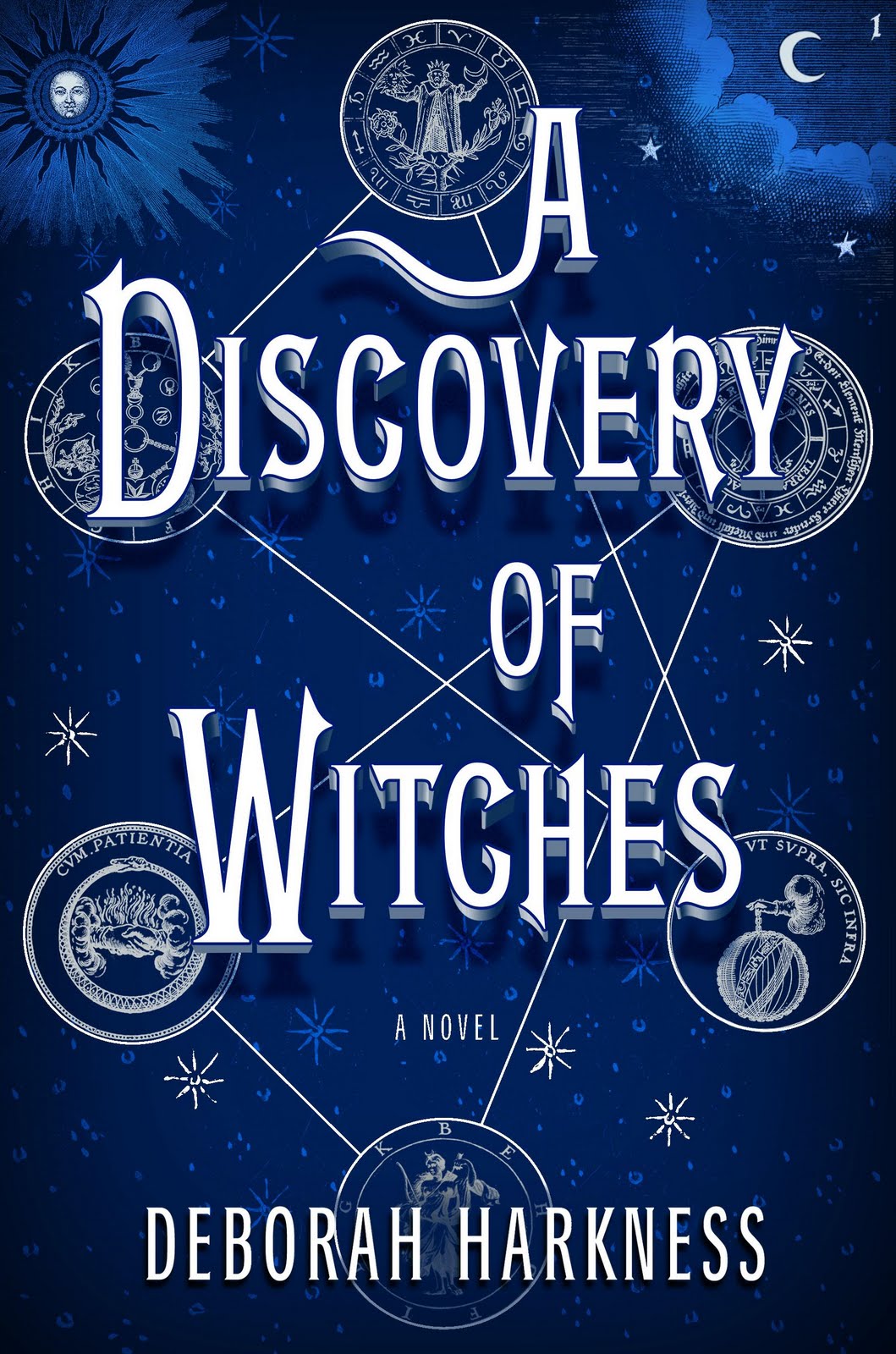
It's Halloween week which means it's time for some fun. When Penguin offered to let me give you all some fun buttons in support of a novel coming out next year called A Discovery of Witches by Deborah Harkness, I couldn't resist.
You'll also be entered to win a finished copy of the book, but that won't arrive until next year.
What's this book about?
It’s the smart, sophisticated story of a witch and a vampire who overcome their differences to investigate a lost alchemical manuscript, Ashmole 782.
I love this stuff! So the deal is that you win a set of the buttons now and a finished copy of the book next year.
Here are what the buttons look like:
There's also one that says, I'm a Human.
Sound good? If you have a US postal address and this sounds like fun to you, fill out the form to enter! And, I've been a little lonely lately, so leave a comment, too, if you're so inclined.
Sunday, October 24, 2010
Review: Twilight Forever Rising by Lena Meydan

I love a good vampire novel, but I have to admit that in recent years I have mostly read YA vampire novels. I was excited to hear about Twilight Forever Rising by Lena Meydan because it was getting great reviews from booksellers and was said to be a stand-out vampire novel. I guess in all honesty I need little convincing, so I dove right in.
The vampire world in Twilight Forever Rising is a little bit complex and takes some getting used to as there are several clans of vampires (which also includes werewolves), each gifted in different areas, and they do have some system of justice and government. These vampires are practitioners of magic so it's a little bit like Harry Potter vampires. :) And the main character of the book, the only one to ever get this perspective told in first person, Darel Dahanavar, is a telepath or empath. He reads people and knows what they are feeling and thinking. This particular gifting makes him uniquely valuable to his house, but also enables him to retain some of his humanity.
Darel does indeed fall in love with an 18 year old girl. She finds out he's a vampire fairly early on and has no issues with it, continuing the absurd sort of vampire love story we all adore. But the love story isn't the main focus of the book though it's crucial to the story, really there's a war brewing. The vampire clans aren't necessarily thrilled to be in peace and some are more power hungry than others leading to all sorts of action, violence, and suspense.
I really enjoyed this book, I'm a complete sucker for vampire tales what can I say? I do think that key elements of story were introduced that will be brought to fruition in later installments. For example, the prologue is never resolved throughout the entire novel! Darel sets a plan in motion for revenge he thinks is brilliant but this plot line also seems to get dropped when events take a certain turn. So as a reader this made me frustrated because who knows when we'll get the rest of the books in English!
But the vampire mythology was rich and interesting. I liked Darel, loved Chris his necromancer friend, and am greatly curious to spend more time with the other houses. The books is told at times through Darel's first person perspective and at times through the third person point of view of other characters. It's hugely ambitious with so many vampire clans all up in each other's business, but it can still be followed quite easily. Please note this book is translated from Russian.
Rating: 4/5
Things You Might Want to Know: Vampires. Also very mild profanity
Source of Book: Review Copy from Publisher
Publisher: Tor
Friday, October 22, 2010
Faith and Fiction Saturday: Who Would You Add to the Bible?
Faith and Fiction Saturday is a weekly discussion about the intersection of faith and fiction. Participate by leaving a comment or writing a post on your own blog.
Okay so the title is more controversial than my actual subject today! In case you don't know, along with all the other Narnia themed books sure to hit the shelves with the release of the Dawn Treader movie, is a C.S. Lewis Bible.
Here's the product description:
C.S. Lewis was one of the intellectual giants of the twentieth century and arguably the most thought provoking and influential Christian writer of his day. For over forty years, generations of readers have found insight and inspiration from his uniquely articulate view of God's interaction in the world and in our lives. The C.S. Lewis Bible is one of the most anticipated Bibles of our time. This NRSV Bible provides readings comprised of selections from Lewis's celebrated spiritual classics, a collection that includes Mere Christianity, The Screwtape Letters, The Great Divorce, The Problem of Pain, Miracles, A Grief Observed, The Weight of Glory and The Abolition of Man, as well as letters, poetry, and Lewis's less-familiar works. Each reading, paired alongside relevant passages in the Bible, offers C.S. Lewis as a companion to a reader's daily meditation of scripture. As people engage in their devotional Bible reading, they will also gain insight from his writings and spiritual journey as they invite Lewis into their spiritual discipline. Key features of this Bible include: - New Revised Standard Version text - the most trusted, accepted, and accurate translation of the Bible on the market - Over 400 selections from C.S. Lewis for contemplation and devotional reading - Introductory essays on C.S. Lewis's view of scripture - Attractive two-color interior (brown/black) - Double-column format, in a readable, classic design - Presentation page for gift-giving
So I was thinking about this. I enjoy C.S. Lewis, a lot actually, but not nearly as much as it seems a lot of other Christians do. So I was wondering what sort of Bible I'd enjoy of another writer. Frederick Buechner? Beth Moore? A.W. Tozer? Henri Nouwen?
How about you? Is there someone so meaningful to you you'd like to have a book like this made for your reading and studying enjoyment?
Thursday, October 21, 2010
The Vampire Diaries Recap and Discussion 2.6: Plan B

Oooooh! I loved this episode! It was a bit heartbreaking (because of Mason and Matt not so much Stefan and Elena) but it was the sort of plot barrels full speed ahead kind of goodness that I love.
So much happened I feel like I don't even know where to start! So I think I'll try something different.
What I Loved
Caroline: I love Caroline. At times her insecurity has annoyed me, but overall I find her character to be one of the more balanced and well drawn. I couldn't help but be touched by the development in the relationship with her mother and with Bonnie. I actually cried a little when she compelled her mother...Caroline shows in some ways more than the other vamps, I believe, how being a vampire has human moments but also monstrous moments. The act of compelling her mother after being truly vulnerable with her was one of both utter selfishness but also kindness. Caroline also gets to be a full character with a range of emotions, acts of courage, and acts of selfishness. Team Caroline!
Bonnie: It's about time Bonnie started coming around! I have to admit to feeling a little bugged that the show doesn't explore more of what it means for Bonnie to be Bonnie with so many powers. She also has the ability to manipulate situations and alter outcomes and her choices have just as much repercussion as the others do. She's in this just as much as they are, but for some reason she gets to be all high and mighty or as Damon calls her judgy. So it was nice to see her reach out to both Elena and Caroline and help the Salvatore brothers.
Jeremy: I LOVED Jeremy telling Elena off. LOVED it. It's about time! He's not some young child that needs sheltering, his life has been dramatically impacted by the presence of the supernatural and he has a right to make choices about that. I am very interested in where Jeremy's arc goes.
Damon: Always and forever. How much do I love that Damon thanks Bonnie for her help, apologizes to Elena for letting Katherine get to him, and also kills Mason in cold blood? And as always he's the funniest. Damon can be brutal and tender hearted and for these reasons, I love him best.
What I didn't like
Elena: UGH!!!! How annoying was she all night? Whenever something little happened and she didn't know about it she got all upset, but she expects everyone else to be fine living in the dark. Also, believing the war is all about her and Stefan and whether or not they're together? Katherine has a lot more winning to do before she's won if you know what I mean!
Matt!!!!!!
So what's next? WHY does Katherine need a werewolf? I have to admit I thought that was amusing when Stefan asked why she'd want the moonstone and Damon had to admit he had no idea. I'm curious as to what her actual plan is. (or her 25 plans. :) I will be really sad if Tyler kills Matt! And how lucky that Jenna didn't die!
Tell me all your thoughts!!!!!!!!!!
FIRST: Two Tickets to the Christmas Ball by Donita K. Paul
Review closer to Christmas!It is time for a FIRST Wild Card Tour book review! If you wish to join the FIRST blog alliance, just click the button. We are a group of reviewers who tour Christian books. A Wild Card post includes a brief bio of the author and a full chapter from each book toured. The reason it is called a FIRST Wild Card Tour is that you never know if the book will be fiction, non~fiction, for young, or for old...or for somewhere in between! Enjoy your free peek into the book!
You never know when I might play a wild card on you!
and the book:
Two Tickets to the Christmas Ball
WaterBrook Press (October 5, 2010)
 Expertly weaving together fantasy, romance and Biblical truths, Donita K. Paul penned the best-selling, fan-favorite DragonKeeper Chronicles series. After retiring early from teaching, she began a second career as an award-winning author and loves serving as a mentor for new writers of all ages. And when she’s not putting pen to paper, Donita makes her home in Colorado Springs and enjoys spending time with her grandsons, cooking, beading, stamping, and knitting.
Visit the author's website.
Product Details:
List Price: $14.99
Hardcover: 240 pages
Publisher: WaterBrook Press (October 5, 2010)
Language: English
ISBN-10: 0307458997
ISBN-13: 978-0307458995
AND NOW...THE FIRST CHAPTER:

With snowflakes sticking to her black coat, Christmas lights blinking around shop windows, and incessant bells jingling, Cora should have felt some holiday cheer.
And she did.
Really.
Just not much.
At least she was on a Christmas errand this very minute. One present for a member of the family. Shouldn’t that count for a bit of credit in the Christmas-spirit department?
Cora planned out her Christmas gift giving in a reasonable manner. The execution of her purchasing schedule gave her a great deal of satisfaction. Tonight’s quest was a book for Uncle Eric—something about knights and castles, sword fights, shining armor, and all that.
One or two gifts purchased each week from Labor Day until December 15, and her obligations were discharged efficiently, economically, and without the excruciating last-minute frenzy that descended upon other people…like her three sisters, her mother, her grandmother, her aunts.
Cora refused to behave like her female relatives and had decided not to emulate the male side of the family either. The men didn’t buy gifts. They sometimes exchanged bottles from the liquor store, but more often they drank the spirits themselves.
Her adult ambition had been to develop her own traditions for the season, ones that sprouted from the Christianity she’d discovered in college. The right way to celebrate the birth of Christ. She avoided the chaos that could choke Christmas. Oh dear. Judgmental again. At least now she recognized when she slipped.
She glanced around Sage Street. Not too many shoppers. The quaint old shops were decked out for the holidays, but not with LED bulbs and inflated cartoon figures.
Since discovering Christianity, she’d been confused about the trappings of Christmas—the gift giving, the nativity scenes, the carols, even the Christmas tree. Every year she tried to acquire some historical background on the festivities. She was learning. She had hope. But she hadn’t wrapped her head around all the traditions yet.
The worst part was shopping.
Frenzy undid her. Order sustained her. And that was a good reason to steer clear of any commercialized holiday rush. She’d rather screw red light bulbs into plastic reindeer faces than push through a crowd of shoppers.
Cora examined the paper in her hand and compared it to the address above the nearest shop. Number 483 on the paper and 527 on the building. Close.
When she’d found the bookstore online, she had been amazed that a row of old-fashioned retailers still existed a few blocks from the high-rise office building where she worked. Truthfully, it was more like the bookstore found her. Every time she opened her browser, and on every site she visited, the ad for the old-fashioned new- and used-book store showed up in a banner or sidebar. She’d asked around, but none of her co-workers patronized the Sage Street Shopping District.
“Sounds like a derelict area to me,” said Meg, the receptionist. “Sage Street is near the old railroad station, isn’t it? The one they decided was historic so they wouldn’t tear it down, even though it’s empty and an eyesore?”
An odd desire to explore something other than the mall near her apartment seized Cora. “I’m going to check it out.”
Jake, the security guard, frowned at her. “Take a cab. You don’t want to be out too late over there.”
Cora walked. The brisk air strengthened her lungs, right? The exercise pumped her blood, right? A cab would cost three, maybe four dollars, right?
An old man, sitting on the stoop of a door marked 503, nodded at her. She smiled, and he winked as he gave her a toothless grin. Startled, she quickened her pace and gladly joined the four other pedestrians waiting at the corner for the light to change.
Number 497 emblazoned the window of an ancient shoe store on the opposite corner. She marched on. In this block she’d find the book and check another item off her Christmas list.
Finally! “Warner, Werner, and Wizbotterdad, Books,” Cora read the sign aloud and then grasped the shiny knob. It didn’t turn. She frowned. Stuck? Locked? The lights were on. She pressed her face against the glass. A man sat at the counter. Reading. How appropriate.
Cora wrenched the knob. A gust of wind pushed with her against the door, and she blew into the room. She stumbled and straightened, and before she could grab the door and close it properly, it swung closed, without the loud bang she expected.
“I don’t like loud noises,” the man said without looking up from his book.
“Neither do I,” said Cora.
He nodded over his book. With one gnarled finger, he pushed his glasses back up his nose.
Must be an interesting book. Cora took a quick look around. The place could use stronger lights. She glanced back at the clerk. His bright lamp cast him and his book in a golden glow.
Should she peruse the stacks or ask?
She decided to browse. She started to enter the aisle between two towering bookcases.
“Not there,” said the old man.
“I beg your pardon?” said Cora.
“How-to books. How to fix a leaky faucet. How to build a bridge. How to mulch tomatoes. How to sing opera. How-to books. You don’t need to know any of that, do you?”
“No.”
“Wrong aisle, then.” He placed the heavy volume on the counter and leaned over it, apparently absorbed once more.
Cora took a step toward him. “I think I saw a movie like this once.”
His head jerked up, his scowl heavier. He glared over the top of his glasses at the books on the shelves as if they had suddenly moved or spoken or turned bright orange.
“A movie? Here? I suppose you mean the backdrop of a bookstore. Not so unusual.” He arched an eyebrow. “You’ve Got Mail and 84 Charing Cross Road.”
“I meant the dialogue. You spoke as if you knew what I needed.”
He hunched his shoulders. The dark suspenders stretched across the faded blue of his shirt. “Reading customers. Been in the business a long time.”
“I’m looking for a book for my uncle. He likes castles, knights, tales of adventure. That sort of thing.”
He sighed, closed his book, and tapped its cover. “This is it.” He stood as Cora came to the desk. “Do you want me to wrap it and send it? We have the service. My grandson’s idea.”
Cora schooled her face and her voice. One of the things she excelled in was not showing her exasperation. She’d been trained by a dysfunctional family, and that had its benefits. She knew how to take guff and not give it back. Maintaining a calm attitude was a good job skill.
She tried a friendly smile and addressed the salesclerk.
“I want to look at it first and find out how much it costs.”
“It’s the book you want, and the price is eleven dollars and thirteen cents.”
Cora rubbed her hand over the cover. It looked and felt like leather, old leather, but in good repair. The book must be ancient.
“Are you sure?” she asked.
“Which?” the old man barked.
“Which what?”
“Which part of the statement am I sure about? It doesn’t matter because I’m sure about both.”
Cora felt her armor of detachment suffer a dent. The man was impossible. She could probably order a book online and get it wrapped and delivered right to her uncle with less aggravation. But dollar signs blinked in neon red in her mind as she thought how much that would cost. No need to be hasty.
Curtain rings rattled on a rod, and Cora looked up to see a younger version of the curmudgeon step into the area behind the counter.
The younger man smiled. He had the same small, wiry build as the older version, but his smile was warm and genuine. He looked to be about fifty, but his hair was still black, as black as the old man’s hair was white. He stretched out his hand, and Cora shook it.
“I’m Bill Wizbotterdad. This is my granddad, William Wizbotterdad.”
“Let me guess. Your father is named Will?”
Bill grinned, obviously pleased she’d caught on quickly. “Willie Wizbotterdad. He’s off in Europe collecting rare books.”
“He’s not!” said the elder shop owner.
“He is.” Bill cast his granddad a worried look.
“That’s just the reason he gave for not being here.” William shook his head and leaned across the counter. “He doesn’t like Christmas. We have a special job to do at Christmas, and he doesn’t like people and dancing and matrimony.”
Bill put his arm around his grandfather and pulled him back. He let go of his granddad and spun the book on the scarred wooden counter so that Cora could read the contents. “Take a look.” He opened the cover and flipped through the pages. “Colored illustrations.”
A rattling of the door knob was followed by the sound of a shoulder thudding against the wood. Cora turned to see the door fly open with a tall man attached to it. The stranger brushed snow from his sleeves, then looked up at the two shop owners. Cora caught them giving each other a smug smile, a wink, and a nod of the head.
Odd. Lots of oddness in this shop.
She liked the book, and she wanted to leave before more snow accumulated on the streets. Yet something peculiar about this shop and the two men made her curious. Part of her longed to linger. However, smart girls trusted their instincts and didn’t hang around places that oozed mystery. She didn’t feel threatened, just intrigued. But getting to know the peculiar booksellers better was the last thing she wanted, right? She needed to get home and be done with this Christmas shopping business. “I’ll take the book.”
The newcomer stomped his feet on the mat by the door, then took off his hat.
Cora did a double take. “Mr. Derrick!”
He cocked his head and scrunched his face. “Do I know you?” The man was handsome, even wearing that comical lost expression. “Excuse me. Have we met?”
“We work in the same office.”
He studied her a moment, and a look of recognition lifted the frown. “Third desk on the right.” He hesitated, then snapped his fingers. “Cora Crowden.”
“Crowder.”
He jammed his hand in his pocket, moving his jacket aside. His tie hung loosely around his neck. She’d never seen him looking relaxed. The office clerks called him Serious Simon Derrick.
“I drew your name,” she said.
He looked puzzled.
“For the gift exchange. Tomorrow night. Office party.”
“Oh. Of course.” He nodded. “I drew Mrs. Hudson. She’s going to retire, and I heard her say she wanted to redecorate on a shoestring.”
“That’s Mrs. Wilson. Mrs. Hudson is taking leave to be with her daughter, who is giving birth to triplets.”
He frowned and began looking at the books.
“You won’t be there, will you?” Cora asked.
“At the party? No, I never come.”
“I know. I mean, I’ve worked at Sorenby’s for five years, and you’ve never been there.”
The puzzled expression returned to Serious Simon’s face. He glanced to the side. “I’m looking for the how-to section.”
Cora grinned. “On your left. Second aisle.”
He turned to stare at her, and she pointed to the shelves Mr. Wizbotterdad had not let her examine. Mr. Derrick took a step in that direction.
Cora looked back at the shop owners and caught them leaning back in identical postures, grins on their faces, and arms crossed over their chests.
Bill jerked away from the wall, grabbed her book, rummaged below the counter, and brought out a bag. He slid the book inside, then looked at her. “You didn’t want the book wrapped and delivered?”
“No, I’ll just pay for it now.”
“Are you sure you wouldn’t like to look around some more?” asked Bill.
“Right,” said William. “No hurry. Look around. Browse. You might find something you like.”
Bill elbowed William.
Simon Derrick had disappeared between the stacks.
William nodded toward the how-to books. “Get a book. We have a copy of How to Choose Gifts for Ungrateful Relatives. Third from the bottom shelf, second case from the wall.”
The statement earned him a “shh” from his grandson.
Cora shifted her attention to the man from her office and walked a few paces to peek around the shelves. “Mr. Derrick, I’m getting ready to leave. If you’re not coming to the party, may I just leave the gift on your desk tomorrow?”
He glanced at her before concentrating again on the many books. “That’s fine. Nice to see you, Miss Crowden.”
“Crowder,” she corrected, but he didn’t answer.
She went to the counter and paid. Mr. Derrick grunted when she said good-bye at the door.
“Come back again,” said Bill.
“Yes,” said William. “We have all your heart’s desires.”
Bill elbowed him, and Cora escaped into the blustering weather.
She hiked back to the office building. Snow sprayed her with tiny crystals, and the sharp wind nipped her nose. Inside the parking garage, warm air helped her thaw a bit as she walked to the spot she leased by the month. It would be a long ride home on slippery roads. But once she arrived, there would be no one there to interrupt her plans. She got in the car, turned the key, pushed the gearshift into reverse, looked over her shoulder, and backed out of her space.
She would get the gift ready to mail off and address a few cards in the quiet of her living room. There would be no yelling. That’s what she liked about living states away from her family. No one would ambush her with complaints and arguments when she walked through the door.
Except Skippy. Skippy waited. One fat, getting fatter, cat to talk to. She did complain at times about her mistress being gone too long, about her dinner being late, about things Cora could not fathom. But Cora never felt condemned by Skippy, just prodded a little.
_
Once inside her second-floor apartment, she pulled off her gloves, blew her nose, and went looking for Skippy.
The cat was not behind the curtain, sitting on the window seat, staring at falling snow. Not in her closet, curled up in a boot she’d knocked over. Not in the linen closet, sleeping on clean towels. She wasn’t in any of her favorite spots. Cora looked around and saw the paper bag that, this morning, had been filled with wadded scraps of Christmas paper. Balls of pretty paper and bits of ribbon littered the floor. There. Cora bent over and spied her calico cat in the bag.
“Did you have fun, Skippy?”
The cat rolled on her back and batted the top of the paper bag. Skippy then jumped from her cave and padded after Cora, as her owner headed for the bedroom.
Thirty minutes later, Cora sat at the dining room table in her cozy pink robe that enveloped her from neck to ankles. She stirred a bowl of soup and eyed the fifteen packages she’d wrapped earlier in the week. Two more sat waiting for their ribbons.
These would cost a lot less to send if some of these people were on speaking terms. She could box them together and ship them off in large boxes.
She spooned chicken and rice into her mouth and swallowed.
The soup was a tad too hot. She kept stirring.
She could send one package with seven gifts inside to Grandma Peterson, who could dispense them to her side of the family. She could send three to Aunt Carol.
She took another sip. Cooler.
Aunt Carol could keep her gift and give two to her kids. She could send five to her mom…
Cora grimaced. She had three much older sisters and one younger. “If Mom were on speaking terms with my sisters, that would help.”
She eyed Skippy, who had lifted a rear leg to clean between her back toes. “You don’t care, do you? Well, I’m trying to. And I think I’m doing a pretty good job with this Christmas thing.”
She reached over and flipped the switch on her radio. A Christmas carol poured out and jarred her nerves. She really should think about Christmas and not who received the presents. Better to think “my uncle” than “Joe, that bar bum and pool shark.”
She finished her dinner, watching her cat wash her front paws.
“You and I need to play. You’re”—she paused as Skippy turned
a meaningful glare at her—“getting a bit rotund, dear kitty.”
Skippy sneezed and commenced licking her chest.
After dinner, Cora curled up on the couch with her Warner, Werner, and Wizbotterdad bag. Skippy came to investigate the rattling paper.
Uncle Eric. Uncle Eric used to recite “You Are Old, Father William.” He said it was about a knight. But Cora wasn’t so sure. She dredged up memories from college English. The poem was by Lewis Carroll, who was really named Dodson, Dogson, Dodgson, or something.
“He wrote Alice’s Adventures in Wonderland,” she said. “There’s a cat in the story, but not as fine a cat as you. He smiles too much.”
Skippy gave her a squint-eyed look.
Cora eased the leather-bound book out of the bag. “The William I met at the bookstore qualifies for at least ancient.”
She put the book in her lap and ran her fingers over the embossed title: How the Knights Found Their Ladies.
She might have been hasty. She didn’t know if Uncle Eric would like this. She hefted the book, guessing its weight to be around four pounds. She should have found a lighter gift. This would cost a fortune to mail.
Skippy sniffed at the binding, feline curiosity piqued. Cora stroked her fur and pushed her back. She opened the book to have a peek inside. A piece of thick paper fell out. Skippy pounced on it as it twirled to the floor.
“What is it, kitty? A bookmark?” She slipped it out from between Skippy’s paws, then turned the rectangle over in her hands. Not a bookmark. A ticket.
Admit one to the Wizards’ Christmas Ball
Costumes required
Dinner and Dancing
and your Destiny
Never heard of it. She tucked the ticket in between the pages and continued to flip through the book, stopping to read an occasional paragraph.
This book wasn’t for Uncle Eric at all. It was not a history, it was a story. Kind of romantic too. Definitely not Uncle Eric’s preferred reading.
Skippy curled against her thigh and purred.
“You know what, cat? I’m going to keep it.”
Skippy made her approval known by stretching her neck up and rubbing her chin on the edge of the leather cover. Cora put the book on the sofa and picked up Skippy for a cuddle. The cat squirmed out of her arms, batted at the ticket sticking out of the pages, and scampered off.
“I love you too,” called Cora.
She pulled the ticket out and read it again: Wizards’ Christmas Ball. She turned out the light and headed for bed. But as she got ready, her eye caught the computer on her desk. Maybe she could find a bit more information.